Google has introduced the Gemini Decisions API, powered by Gemini Decision 1.
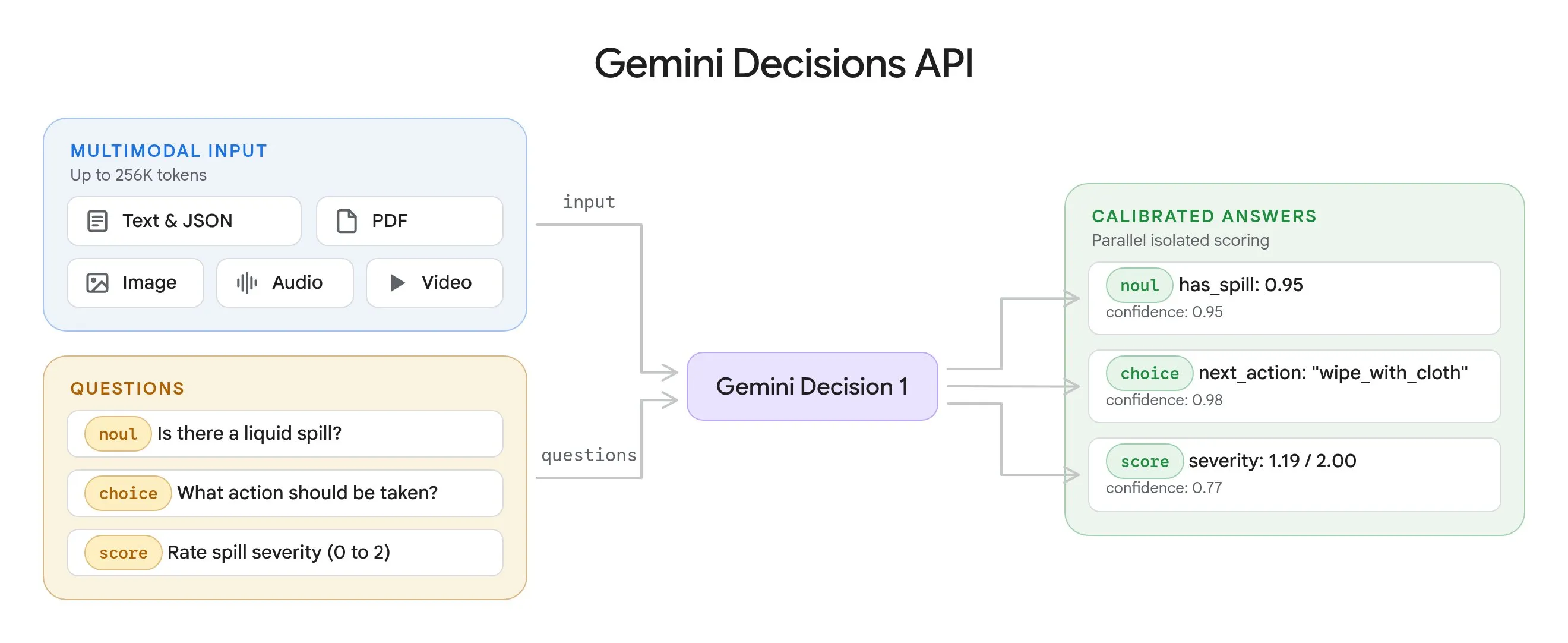
Image source: Google
Instead of generating text token by token, it evaluates shared input and returns typed decisions with probabilities and confidence scores in one pass.
What stood out
- Supports text, images, audio, video, and PDFs
- Evaluates up to 1,000 independent questions per request
- Supports yes/no, fixed-choice, and rubric-scoring decisions
- Costs $0.10 per 1M input tokens, with no output-token charge
Quick comparison
| API / model | Input | Questions per request | Input price | Output price |
|---|---|---|---|---|
| Gemini Decision 1 | Text, JSON, images, audio, video, PDFs | Up to 1,000 | $0.10 / 1M tokens | Free |
| TypeSafe Jev 1.14 | Text, JSON, images | Context-bound; no separate question limit | $0.042 / 1M tokens | Free |
| OpenAI GPT-6 Luna | Text, JSON, images, conversation and tool history | Up to 400 | $0.10 / 1M uncached tokens | Free |
How they fundamentally differ
All three are decision models, not general text generators. You provide a closed answer space, and the model scores the candidates directly instead of autoregressively writing and then parsing a response. This makes them better suited to routing, moderation, policy checks, ranking, and other decisions that code must consume.
The main difference is what each system is optimized around:
- Gemini Decision 1 uses Gemini’s native multimodal architecture to score many isolated questions over the same text, image, audio, video, or PDF input in a single forward pass. It has the largest fixed question limit and broadest media support.
- Jev is TypeSafe’s purpose-built “System One” model, trained with Reinforcement Learning for Calibrated Decisions. It exposes
Noul,Choice,Score, and an imageBoxprimitive. It is the cheapest here and has no separate question-count limit, but does not natively accept audio or video. - OpenAI’s Decisions API uses the dedicated GPT-6 Luna model and exposes
predicate,choice, andscorequestions. Its distinction is workflow integration: it can evaluate conversation history, function/tool calls, and JSON directly, and supports prompt caching.
Their low-level architectures are not fully public, so the safest comparison is their observable contract: all return bounded, probabilistic decisions; they mainly differ in modalities, primitives, batching limits, workflow context, and pricing.
TIL
Decision-first models are becoming a distinct model category:
- Pick Gemini for native multimodal input or large batches of questions.
- Pick Jev for lower-cost decisions or its bounding-box primitive.
- Pick OpenAI when decisions need existing OpenAI conversation, tool-call, or caching workflows.
Confidence is still a routing signal, not a guarantee. Test it on labeled data from your own application before automating high-impact actions.